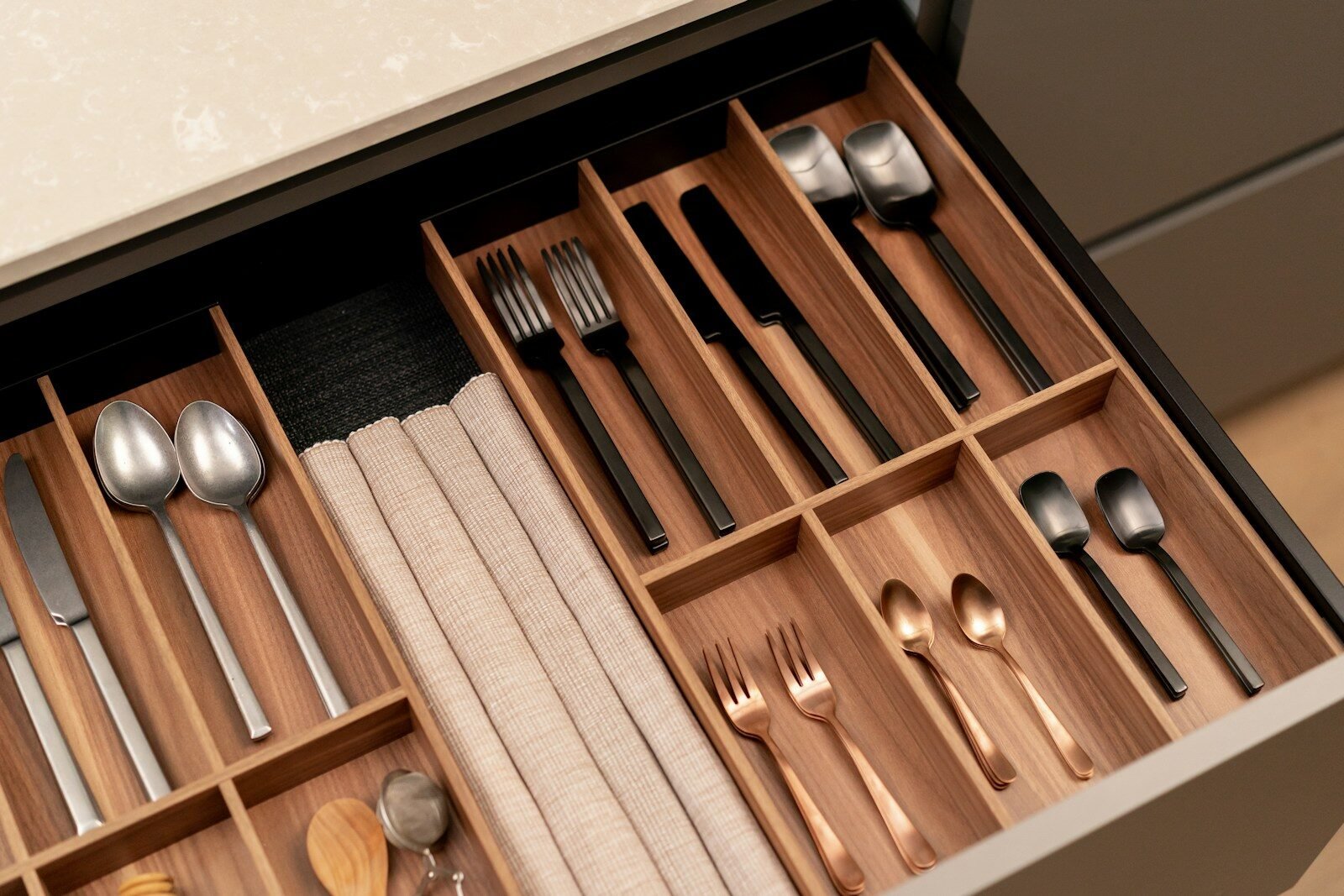
A kitchen drawer organiser is one of the most impactful changes you can make to the way your mornings feel. Most people buy the wrong one, discover it does not quite fit, and end up with the same chaos rearranged around a tray.
This guide covers what actually works, why most generic advice gets this wrong, and how to choose the right organiser for the specific drawers in your kitchen rather than a hypothetical kitchen with standard dimensions that does not exist.
The problem with most kitchen drawer advice
Most drawer organisation guides tell you to declutter first, measure second, and buy third. That order sounds sensible. It is not.
The real problem is that UK kitchen drawers do not come in standard sizes. A 600mm base unit from one manufacturer will have a different internal dimension to the same nominal size from another. Wren, Howdens, IKEA, and bespoke fitted kitchens all vary, sometimes by as much as 30 to 40mm in width and 15 to 20mm in depth. An organiser that fills a Howdens 500mm unit perfectly will rattle around in a Wren equivalent.
The first step is not decluttering. It is measuring the internal cavity, not the external unit, with a tape measure, noting three numbers: internal width, internal depth, and internal height. Do this before you look at a single product.
UK kitchen drawer dimensions: what you are actually working with
These are the most common internal measurements found in standard UK kitchen base unit drawers, not the external carcass size:
| Unit Size | Typical Internal Width | Typical Internal Depth | Common in |
|---|---|---|---|
| 300mm base | 250–270mm | 390–440mm | Spice, small utensil |
| 400mm base | 350–370mm | 390–440mm | Cutlery, utensils |
| 500mm base | 450–470mm | 390–440mm | Cutlery, utensils |
| 600mm base | 540–565mm | 390–440mm | Most common size |
| 800mm base | 730–755mm | 390–440mm | Pan lids, larger tools |
| 1000mm base | 930–955mm | 390–440mm | Deep pan drawers |
Deep drawers, those with 200mm or more of internal height, are increasingly common in handleless and Shaker-style kitchens, particularly in designs from 2018 onwards. A standard organiser tray, typically 50 to 60mm high, will sit at the bottom and leave a significant unusable gap above. This is where a two-tier or stackable system is worth the additional investment.
What a kitchen drawer organiser actually changes
The impact of a well-organised kitchen drawer goes beyond the visual. Research published in Personality and Social Psychology Bulletin found that people with cluttered environments showed higher cortisol levels across the day. This effect was strongest in domestic spaces like the kitchen. A 2022 study in the Journal of Environmental Psychology connected workspace organisation directly to decision fatigue: environments that reduce small daily decisions preserve mental bandwidth for more significant ones.
Every time you reach into a drawer and have to move three things to find the one you want, you spend a small decision. Over the course of a week, those add up. People who track this kind of thing estimate that unorganised kitchens cost between 10 and 15 minutes of productive time per day, time spent searching, replacing, and re-searching.
A kitchen utensil drawer organiser does not just create order. It removes a category of friction entirely.
Materials compared: what actually lasts in a kitchen
Most buying guides are vague here because most guides do not consult kitchen designers or materials scientists. Here is what the evidence shows.
Bamboo
Bamboo is not wood in the conventional sense. It is a grass with a silica content that gives it natural resistance to moisture and bacteria. In a kitchen environment where drawers are opened with damp hands and small amounts of residue transfer from utensils, bamboo outlasts softwood and MDF significantly. Independent testing by materials labs has found bamboo resists warping at relative humidity levels up to 65 to 70 per cent, which covers most British kitchens, including those with poor ventilation or single-glazed windows.
Lifespan in normal kitchen use: 7 to 12 years with basic care. Wipe down regularly and dry before replacing wet utensils.
Acrylic
Clear acrylic organiser trays are particularly effective because they eliminate visual search time: you can see through the tray to what is beneath. The practical advantage over bamboo is that acrylic is non-porous and does not absorb odours or staining from spices, oils, or sauces.
Acrylic is more brittle than bamboo under impact. Dropping a heavy pan into the drawer will crack thin acrylic. Quality acrylic, typically 3 to 4mm thickness, is substantially more durable than budget alternatives, often 1 to 2mm.
Lifespan: 5 to 8 years depending on impact exposure.
MDF and melamine-coated wood
Common in budget organiser trays. Melamine coating resists surface moisture, but the substrate absorbs it at edges and joins. In kitchen environments, MDF organiser trays typically show swelling, warping, and coating separation within 2 to 3 years. Not recommended for regular kitchen use.
Stainless steel
Rarely seen in drawer organisers but worth considering. Completely moisture-proof, impact-resistant, and aesthetically consistent with professional kitchen aesthetics. Cold to the touch, which some find uncomfortable. Heavier than alternatives, which matters in large drawer configurations. Lifespan: indefinite, with correct gauge, minimum 0.8mm for structural integrity.
The Gebenco approach: the drawer as a ritual space
We work from a belief that the external environment shapes the internal experience. The quality of the spaces you interact with daily determines, in part, the quality of the days you live in them.
The kitchen drawer is not just storage. It is the first contact point of the morning: the drawer you open for the coffee spoon, the one you reach into for the knife when you are making breakfast, the one that should open cleanly and deliver exactly what you need without interruption.
We call this the Ritual of Care, the belief that the spaces around food preparation deserve the same intentional design as any other part of a considered home. The organiser is not decorative. It is structural to that ritual.
This is why we select materials for how they behave over years of daily use, not just how they photograph on a product page. The right system depends on what you cook, how you work, and what your kitchen actually needs.
Choosing by cooking habit, not just by space
The standard advice, measure your drawer and buy to fit, gets you to a working solution. It does not get you to the right one.
If you cook daily from scratch, you reach for the same six to eight tools every morning. Those tools should have front-of-drawer positions in a dedicated compartment, not mixed into a general tray. A divided organiser with a dedicated daily-use zone at the front reduces reach time and eliminates the reflex rummage.
If you cook less frequently but entertain, your drawer use is episodic and bulkier: serving spoons, specialised tools, carving sets. A wider-compartment organiser with fewer, larger sections works better than a highly divided cutlery-style tray.
If you have a deep drawer, 200mm or more of internal height, a single tray organiser wastes the majority of the available space. A two-tier system with a slide-out upper tray for daily items and a lower section for occasional tools makes full use of the volume.
If you have a wide drawer, 800mm or more of internal width, a single organiser will leave gaps at the sides unless it is adjustable or you use two side-by-side. Gaps allow items to fall behind the organiser and recreate the chaos you were solving.
Top Picks from Gebenco
We have curated a range of kitchen drawer organisers selected for material integrity, longevity, and compatibility with UK kitchen dimensions. The range includes bamboo modular systems, adjustable acrylic configurations, and deep-drawer solutions.
Explore the Kitchen Collection
The five mistakes people make when buying a kitchen drawer organiser
1. Measuring the unit, not the cavity. The external carcass is not the internal space. Measure inside the drawer with the drawer fully open and a steel tape measure. Fabric tapes stretch.
2. Buying for the aesthetic, not the habit. A beautiful bamboo tray that requires you to relocate three items to reach the peeler is not solving the problem. It is decorating it.
3. Ignoring the drawer height. Almost everyone measures width and depth. Very few measure height. In a deep drawer, a standard 55mm tray uses less than a third of the available vertical space.
4. Choosing non-adjustable in a non-standard space. Most UK kitchens, particularly those retrofitted or renovated, do not have perfectly standard cavities. An adjustable divider system accommodates the reality of your kitchen rather than requiring the kitchen to conform to the product.
5. Buying one organiser for all drawers. Cutlery, utensils, and baking tools have different access patterns and different space requirements. A single organiser type applied across all drawers is a compromise for each.
FAQ
What size kitchen drawer organiser do I need for a standard UK 600mm unit?
For a standard 600mm base unit, the internal width is typically 540 to 565mm depending on the manufacturer and hinge type. Look for an organiser with a maximum width of 535mm, or an adjustable system that expands to 560mm. Depth is usually 390 to 440mm internally, and most organisers are designed around 380 to 430mm, so depth is rarely the constraint.
What is the best material for a kitchen drawer organiser in the UK?
For most UK kitchens, bamboo is the strongest long-term choice. It is moisture-resistant, anti-bacterial, does not warp at typical indoor humidity levels, and sits well across Japandi, Scandi, and contemporary kitchen styles. Acrylic is the better choice if you want full visibility of drawer contents or have children who are hard on interiors. Avoid MDF and melamine-coated wood for kitchen use: they degrade significantly within 2 to 3 years.
How do I organise a deep kitchen drawer?
A standard tray organiser in a deep drawer, 200mm or more of internal height, only uses the lower portion of the space. Use a two-tier system: a pull-out upper tray for daily tools, spatulas, peelers, the things you reach for every morning, and a lower section for occasional items. This structure reduces visual clutter and makes the system easier to maintain, because daily-use items always return to the same accessible position.
Can I use a kitchen drawer organiser in a bathroom or bedroom?
Yes. The same principles, designated space for each item, visible at a glance, stable in position, apply in any drawer in any room. Bamboo and acrylic are both appropriate for bathroom humidity levels. For bedroom use, any material works and the decision is entirely aesthetic.
Is a kitchen drawer organiser worth it for a rented property?
Yes. A good organiser is non-permanent, portable, and transferable to a new property. The daily time saving applies regardless of whether you own the kitchen. Most bamboo and acrylic systems also clean easily for end-of-tenancy, which matters if your deposit depends on the condition of the property.
The kitchen is the room that asks most of you each day. A well-chosen drawer organiser, selected for your actual space, your actual habits, and materials that hold up over time, is one of the quieter ways to make that experience feel like less.
Explore the Kitchen Collection
Published by Gebenco | Last reviewed: June 2026 | Kitchen Organisation