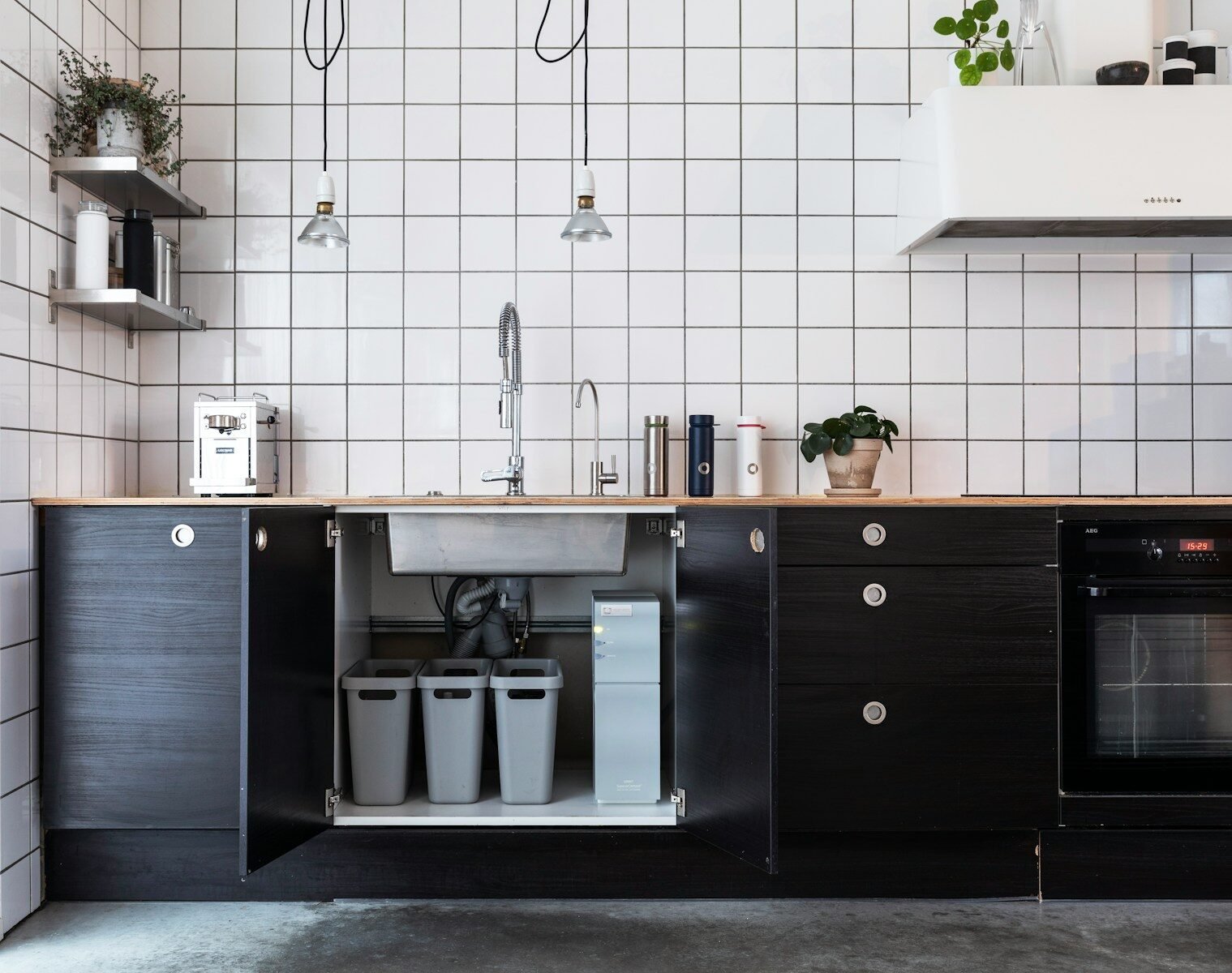
Kitchen under sink storage is one of the most consistently wasted spaces in a British home. The cabinet is there. The need is obvious. Yet most attempts to organise it end with a tray that does not fit, a rack that blocks the waste pipe, or a system that looked logical in the shop and makes no sense once the door closes.
The problem is rarely the product. It is the order of decisions. This guide covers the six mistakes that make under-sink storage fail, what to measure before you buy anything, and how to choose a solution that actually works with the plumbing rather than around it.
Why under-sink storage is harder than it looks
The under-sink cabinet in a British kitchen is not simply a box. It contains a sink bowl that drops 150 to 200mm below the countertop surface, a waste pipe and P-trap that occupy a fixed position determined by your plumbing, hot and cold supply pipes that typically rise from below, and often a dishwasher or washing machine connection point as well.
The usable floor space is smaller than the cabinet dimensions suggest, the height varies depending on where the waste pipe exits, and the awkward geometry means that most standard storage products assume a configuration that does not exist in your actual kitchen.
Understanding this before you buy saves the trip back to the shop.
Mistake 1: Measuring the cabinet, not the usable space
This is the most common and most costly error. The nominal size of a kitchen base unit, whether 500mm, 600mm, or 800mm, refers to the external carcass. The internal cavity is narrower, typically by 40 to 50mm. The sink bowl reduces usable height on one side. The waste pipe and P-trap occupy a portion of the rear floor space.
Before purchasing any under sink organiser, take three measurements inside the cabinet with the door open:
- Usable width at floor level, accounting for any pipe runs along the sides
- Clearance height from floor to the underside of the sink bowl, on both the left and right sides separately (they are often different)
- Depth from front to back, noting where the waste pipe exits and how much floor space remains in front of it
The floor space in front of the P-trap is where most of your storage actually lives. Knowing this dimension precisely tells you what will fit and what will not before you commit to anything.
Mistake 2: Buying products that ignore the P-trap
The P-trap is the curved section of waste pipe beneath every sink. It sits roughly in the centre-rear of the cabinet, at a height of approximately 200 to 350mm from the floor depending on the installation. It is not removable and cannot be relocated without replumbing.
Most under-sink shelving and rack systems are designed for the American market, where waste pipes typically exit through the wall at a higher position. In British kitchens, the P-trap sits lower and further forward, meaning many products that fit in terms of width and depth will still block or be blocked by the waste pipe.
The solution is to choose systems designed to accommodate or work around a central obstacle: U-shaped shelves, pull-out drawers that sit either side of the P-trap, or adjustable modular trays that configure around the pipe rather than assuming clear floor space. Measure the height and horizontal position of your P-trap before purchasing anything with a fixed central structure.
Mistake 3: Using a single-tier system in a space that needs two tiers
The height above the P-trap, on the left and right sides of the cabinet, is typically 250 to 400mm of clear vertical space. A standard single-tier tray or shelf uses perhaps 80 to 100mm of that. The rest goes unused.
A two-tier approach, with a raised shelf or pull-out upper tray above the floor-level storage, can double the effective capacity of the cabinet without adding a single centimetre to its footprint. Items used less frequently, cleaning products bought in bulk, spare sponges, sit on the upper tier. Daily-reach items stay at floor level where they are accessible without crouching.
The constraint is that the upper tier must clear the P-trap and supply pipes. Measure the height of your P-trap and the lateral space on either side before selecting a two-tier system. Many are adjustable in height specifically for this reason.
Mistake 4: Choosing materials that fail in a damp environment
Under-sink cabinets are exposed to occasional drips, condensation on cold pipes, and higher ambient humidity than the rest of the kitchen. It is a genuinely damp environment and most materials suffer for it.
MDF swells at the edges when moisture penetrates the surface coating. Chipboard dissolves. Cardboard-backed wire racks corrode at the joins. Even untreated bamboo, excellent in most kitchen contexts, can develop surface mould in a consistently wet environment.
For under-sink storage, the strongest material choices are:
Coated wire or chrome-plated steel. Moisture does not affect the structure. Any surface rust on lower-quality products is a sign of inadequate coating rather than an inherent flaw in the material.
High-density polyethylene (HDPE) or polypropylene trays. Non-porous, non-absorbent, and fully waterproof. Not aesthetically neutral but functionally excellent under a sink where nothing is on display.
Powder-coated steel. The coating resists moisture well if unscratched. More durable than wire chrome in most domestic under-sink environments.
Bamboo is appropriate for under-sink use only in well-ventilated cabinets with no active leaks or condensation. If your pipes sweat in cold weather, choose coated steel or HDPE instead.
Mistake 5: Organising without a door clearance check
Under-sink cabinet doors in British kitchens are almost always hinged, not sliding. The door swings outward and the hinges are set into the side of the carcass. Many organiser systems, particularly those with pull-out drawers or swing-out racks, require the door to open to 90 degrees or more before the mechanism functions correctly.
In a kitchen where the cabinet sits adjacent to a dishwasher, a corner unit, or an island, the door may not open to a full 90 degrees. A pull-out rack that requires 100mm of door-clearance travel will bind or scratch against the door frame.
Before purchasing any sliding, swinging, or pull-out under-sink system, open your cabinet door to its maximum and measure the clearance arc. Confirm the product’s minimum door-opening requirement before buying.
Mistake 6: Buying before decluttering the pipe zone
The instinct to buy storage first and then work out what goes in it produces a specific kind of failure under the sink. Products accumulate in the cabinet over years: half-empty cleaning fluids, duplicate sponges, plastic bags from deliveries, things placed there temporarily that became permanent. When you add a new organiser on top of this accumulation, the system has to accommodate everything rather than what you actually use.
The right order is to remove everything from the cabinet first. Discard what is expired, empty, or unused. Group what remains by frequency: daily reach, weekly, and occasional. Only then does the organiser selection become clear, because you are configuring storage for a known set of things rather than an unknown volume of everything.
Most people discover, at this stage, that they need less storage than they assumed and better storage than they had.
The Gebenco approach: the cabinet as an intentional space
We design around the belief that the spaces you cannot see matter as much as the ones you can. A calm, organised kitchen does not begin with the surfaces. It begins with the systems behind the cupboard doors, the drawers that open cleanly, and the cabinet under the sink that does not require a search every time you need the washing-up liquid.
Under-sink storage done well is invisible. You open the door, you find what you need, and you close it. That unremarkable moment, repeated every day, is what an organised home actually feels like.
Explore the kitchen organisation range at Gebenco, selected for real British kitchen dimensions and materials that hold up in damp environments.
FAQ
What is the best under sink organiser for a UK kitchen?
The best kitchen under sink storage system for a UK kitchen is one designed to work around a central P-trap. Look for U-shaped shelves, adjustable pull-out drawers, or modular two-tier systems that configure around the waste pipe rather than assuming clear floor space. Coated wire or powder-coated steel are the most durable materials for the damp under-sink environment. Measure internal width, clearance height on both sides of the sink bowl, and P-trap position before purchasing.
How do I maximise storage under a kitchen sink?
Use a two-tier approach: a raised shelf or pull-out upper tray on either side of the P-trap for less frequently used items, and accessible floor-level storage for daily products. Pull-out systems are more practical than fixed shelves because they bring items at the back of the cabinet within reach without crouching. Declutter first, then measure, then select a system configured for what you actually keep under the sink.
Why does everything fall over under my kitchen sink?
Items fall over under the sink when the storage system does not create stable, defined positions for individual products. Flat trays without dividers allow bottles to tip when the door opens or closes. A modular organiser with designated compartments, or a pull-out rack where bottles sit in individual slots, solves this. Choosing stable, flat-bottomed products rather than round bottles also reduces the problem significantly.
Can I add a pull-out shelf under my kitchen sink?
Yes, if the door clearance allows it. Pull-out shelves require the cabinet door to open to at least 90 degrees before the slide mechanism can extend. Check your door’s maximum opening arc, particularly if the cabinet sits next to a dishwasher or adjacent unit. Also confirm that the pull-out system clears the P-trap and supply pipes when extended, as these are often positioned directly in the path of the slide.
What should I store under the kitchen sink?
Daily-use cleaning products, washing-up liquid, sponges, and bin liners belong at the front within easy reach. Less frequent items, such as spare cleaning products bought in bulk, should sit behind or above on a second tier. Items that do not belong under a sink at all include anything moisture-sensitive, anything that needs to stay at a consistent temperature, and anything stored there temporarily that has remained permanently for more than a month.
The under-sink cabinet is not a difficult space. It asks for accurate measurements, an honest assessment of what belongs there, and a product chosen for real dimensions rather than optimistic ones. The quiet satisfaction of opening it and finding exactly what you need is not a small thing.
Published by Gebenco | Last reviewed: June 2026 | Kitchen Organisation